|
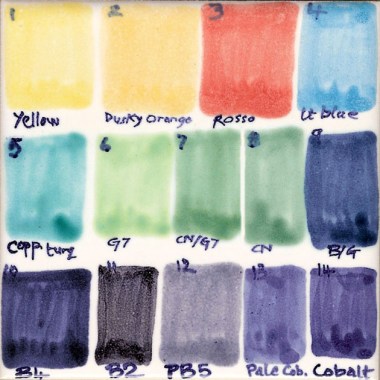
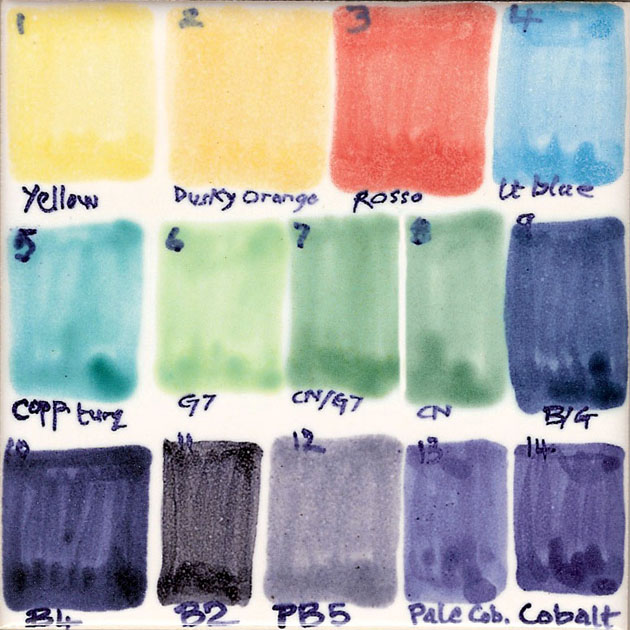
This is to give an idea of the
colours and is a fairly accurate representation but an exact match is
impossible due to the nature of the technology. |
||||
| naples yellow | orange | rosso red | light blue | copper turq. |
![]() |
![]() |
![]() |
![]() |
![]() |
| CNgreen | green13 | g7 | gy4 | gy1 |
![]() |
![]() |
![]() |
![]() |
![]() |
| cobalt blue | cobalt carb. | darkblue 1 | b4 blue | b2 blue |
![]() |
![]() |
![]() |
![]() |
![]() |
| black | manganese | darkblue 2 | purpleblue 5 | blue green |
![]() |
![]() |
![]() |
![]() |
![]() |
| Tin
Glaze Tin glazed ware is variously called Majolica, Faience and Delftware. It is a lead glaze made opaque by the addition of about 10% of tin oxide. Tin glaze was developed by the Persians to imitate the Chinese porcelain that was passing through Persia in the 11th Century. The Moors then brought the technique to Spain where it rapidly spread throughout Europe. The bisque (unglazed) tiles are hand dipped in tin glaze and left to dry for a day or two before painting. We then paint on them with various mixtures of oxides and underglaze colours. The tiles are then fired to about 1040°C in an electric kiln. During the firing process the tin in the glaze absorbs the colour so that it becomes part of the glaze, hence this method is also called in-glaze. ..................................................................................................................................................................... |
||||
| Alkaline Colours: The ranges shown on an alkaline glaze are the Urchins and Echinoids but many of the designs would adapt well onto an alkaline glaze. |
||||
| Turquoise 1 | Turquoise 2 | Turquoise 3 | Turquoise 4 | Green |
![]() |
![]() |
![]() |
![]() |
![]() |
| Blue 1 | Blue 2 | B2 blue | Purple Blue | Copper Ox |
![]() |
![]() |
![]() |
![]() |
![]() |
| Alkaline
Glaze This glaze can be originated back to the Romans , and was made by crushing quartz. A glaze high in silica, it is a 'soft' glaze fired to 1000°C in an electric kiln. It has a critical top temperature - if over-fired it runs off the tile. The glaze crackles as it cools and the size of the crackle can be controlled by the speed of cooling. Salts sometimes come out of the glaze years later but can just be wiped off with a damp cloth. Cobalt, copper and manganese oxides painted under this glaze give very rich colours. The line sometimes runs slightly during firing. We have developed our own glaze recipe over several years to achieve these rich and vibrant colours. We originally started work on developing this glaze in 1989 with a development grant from Greater London Arts. |
||||